Share Governor Warren Eastman Hearnes's obituary with others.
Invite friends and family to read the obituary and add memories.
Stay updated
We'll notify you when service details or new memories are added.
You're now following this obituary
We'll email you when there are updates.
Select your format and elements to print

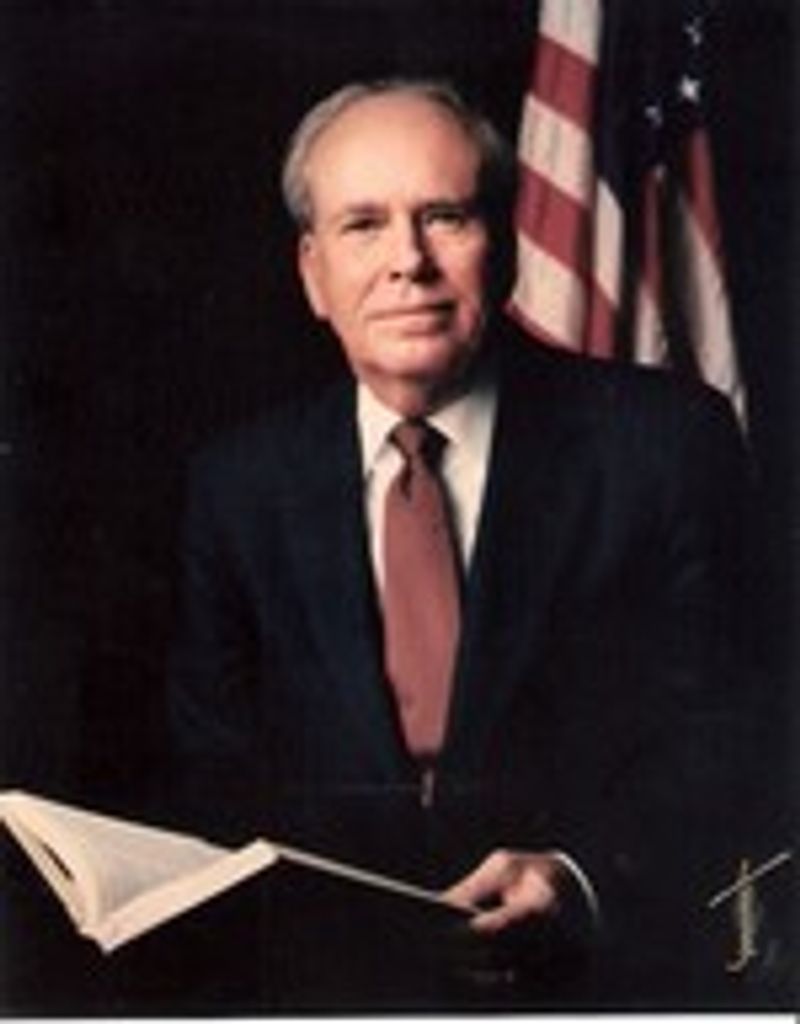
1923
Warren
2009


Governor Warren Eastman Hearnes
Jul 24, 1923 — Aug 16, 2009
Charleston
WARREN EASTMAN HEARNES
Warren Eastman Hearnes, 86, 46th Governor of the State of Missouri, passed away of natural causes August 16, 2009, at his beloved home in Charleston, Missouri. He was the first Missouri Governor to serve two consecutive four year terms in office. He also stands as one of the most unique of all Missouri public officials, as the first person in Missouri history to serve in all three branches of government during his public service career.
The accomplishments of his administration touched the lives of every Missourian and continue to dramatically impact their lives today through the improvements he made as Governor in education, mental health, economic development, civil rights, tourism, and the arts.
As Governor, Hearnes brought Missouri out of the dark ages of custodial care to become a pioneer in mental health rehabilitation. Thanks to him, Missouri led the nation in supporting an effective system of state hospitals, using cutting-edge strategies to treat addiction, a state-of-the-art prototype youth treatment center, the nation's first intensive, short-term treatment programs including treatment for substance abuse with follow-up in the community, and a network of community mental health services that put help within an hour's drive of any community in the state. The nine new regional diagnostic and treatment clinics that he established to treat those with mental illness were unprecedented.
Governor Hearnes fight to increase funding for education led to great improvements in Missouri's education system. During his administration, elementary and secondary school funding increased 167%, higher education funding 204%, vocational education funding 933% and junior college funding 812%. Five new junior colleges were created, 31 area vocational schools were created, and junior colleges in St. Joseph and Joplin were elevated to become the four year institutions Missouri Western State College and Missouri Southern State College. Specific changes were made in the school foundation formula, earmarking a specific percentage for teachers' salaries. Kindergarten programs were established in every Missouri school district and special education programs expanded.
Due to his economic development efforts, new companies such as Cheeseborough Pond, Scholastic, and Westinghouse came to Jefferson City, 3M Company to Nevada, Dundee Cement to northeast Missouri, Ball Bearing Company to Joplin, Lily and General Electric to Springfield, Kroger to St. Louis, Schwitzer Division of Wallace-Murphy Corporation to Rolla, National Lock Company to Sikeston, Proctor and Gamble to Cape Girardeau and Noranda to New Madrid.
He signed Missouri's first civil rights act, the Public Accommodations Law, and was responsible for the state's first air pollution law and the creation of the Clean Water Commission, the Missouri Division of Highway Safety, the Missouri Tourism Commission, the State Highway Patrol Training Academy, and the State Fire Marshall's office. At Betty's urging, he made Missouri the second state in the United States to create a state-funded Council of the Arts. He championed restoration of the Governor's Mansion, preserving this historical treasure for thousands of visitors to enjoy today and renovated the Governor's Office.
Born in Moline, Illinois, on July 24, 1923, the son of Earle and Edna Eastman Hearnes, Warren grew up in Charleston, Missouri. After high school graduation, he attended college at the University of Missouri in Columbia for a year and a half until he was drafted and reported to duty at Fort Sheridan, Illinois. However, fate intervened with an appointment from President Franklin Roosevelt to the United States Military Academy at West Point where he graduated in 1946.
Upon graduation as an infantry officer, he reported to his first tour of duty with the 35th Division of the U.S. Army in Puerto Rico. His military career was ended by a freak accident during a friendly softball game with his men. Medical complications from a broken right ankle left him with a lifelong limp.
While convalescing in Charleston, he began dating Betty Cooper, daughter of a Charleston Baptist minister. On July 2, 1948, Warren and Betty became lifelong partners in life and later in politics. They even shared the same birthday. Following her years as First Lady, Betty was elected to the Missouri House of Representatives in 1978 and served for ten years. In 1988, she was the Democratic nominee for Missouri Governor.
After his medical discharge, Warren and his family returned to Missouri and moved to Columbia where Warren pursued his law degree at the University of Missouri. In 1951, he won his first elected office as the youngest person ever to represent Mississippi County in the Missouri state legislature. At the close of his first term in the Missouri House of Representatives, he received his law degree in 1952 and opened his first law practice in East Prairie.
In 1957, he was elected Majority Floor Leader by his colleagues and re-elected to that post in 1959, making him the first person to be elected to that post twice with no opposition. During his decade in the Missouri House, he introduced 52 bills, co-authored 114 bills, and guided 241 bills through the General Assembly. Twenty-two pieces of Hearnes legislation were signed into law. Among his sponsored bills was one establishing the Missouri Teachers' Retirement System, still considered one of the best in the country, and Amendment 4, which allowed municipalities to issue their own bonds for industrial development.
From 1961 to 1965 he served as Missouri's Secretary of State and in 1962 dropped the political bombshell that he would seek the Governor's office in 1965. For over 20 years in Missouri, an exclusive coalition of powerful Democrats had handpicked the Democratic candidate and Hearnes bucked the system as the anti-Establishment candidate. Putting an unprecedented grassroots campaign of Hearnes for Governor Clubs together in almost every Missouri county and concentrating on carrying St. Louis County brought Hearnes the Democratic nomination by 51,000 votes and in November the governorship by over 400,000 votes.
Warren was one of the most accessible Governors in Missouri history, keeping his morning schedule open before legislative session so any legislator could reach him and installing a special telephone number for their calls. He also initiated the practice of Monday luncheon meetings with Senate and House floor leaders and monthly meetings with the Senate President Pro Tem and House speaker. Unheard of for an incoming Governor, he sat through the appropriations hearings and funding appeals before writing his budget.
As one of the nation's youngest and most popular governors, he gained prominence on the national stage and had strong relationships with Presidents Kennedy and Johnson. In 1967 he hosted the Midwestern Governor's Conference at the Lake of the Ozarks and in 1970 hosted the National Governors Conference for the first in 34 years in Missouri.
After leaving the Governor's office, Warren ran for the U.S. Senate in 1976 but lost in the primary to Jerry Litton. Following Litton's tragic death in a plane crash on his way to a primary election victory party, Warren became the nominee, but was unsuccessful in the general election. In 1978, he was defeated in a bid for Missouri State Auditor.
Following the Auditor's race, Warren took over as Executive Director of Southeast Missouri Legal Services, assisting low income people with legal services for the next 16 years in that capacity. In 1980, he served as a Circuit Court Judge. Following the close of his St. Louis law firm in 1976, he maintained his law office in Charleston, going there daily until ill health prevented it. In 1995, Warren and Betty were awarded the Missouri Citizens for the Arts Advocacy Award.
Those interested in the Hearnes administration can tour the Hearnes Museum in Charleston, which is filled with the photographs, correspondence and memorabilia of this man who was the center of the political world of his time in Missouri.
The Hearnes Multipurpose Building at the University of Missouri in Columbia, Hearnes Hall in Joplin, Hearnes Psychiatric Center and Hearnes Children and Youth Center in Fulton, Hearnes Learning and Resource Center in St. Joseph, Hearnes Building at the Missouri State Chest Hospital in Mt. Vernon and Warren E. Hearnes Elementary School in Charleston all bear his name.
Governor Hearnes was a Shriner and a member of the American Legion, the Veterans of Foreign Wars, the Fraternal Order of Eagles, the Lions Club and the Missouri Bar Association.
Governor Hearnes is survived by his wife Betty of the home; three daughters and two sons in law, Lynn Hearnes, Leigh and Cary Hammond, and Julie Hearnes and Dan Sindelar, all of St. Louis; four grandchildren, Clayton and Catherine Hammond, and Britten and Andrew Sindelar, all of St. Louis.
In addition to his parents, Governor Hearnes was preceded in death by three brothers, Donald Hearnes, Richard Hearnes, and Robert Hearnes; also one sister, Eleanor Hequembourg.
His body will lie in state in the Missouri Capitol Rotunda after 10:00 a.m. Wednesday, August 19, 2009. The official State Funeral Service is scheduled for 2:00 p.m. Wednesday afternoon in the Capitol Rotunda with The Honorable Jeremiah W. (Jay) Nixon, Governor of Missouri officiating.
Governor Hearnes will then lie in state at the First Baptist Church in Charleston, Thursday, August 20, 2009, from 5:00 p.m. until 8:00 p.m. Funeral Services will be conducted Friday at 11:00 a.m. with The Honorable Jeremiah W. (Jay) Nixon, Governor of Missouri, and the Rev. Michael Brewer, Pastor of the First Baptist Church in Charleston, officiating.
The Missouri National Guard under the direction of Adjutant General Steve Danner will conduct Military Graveside Rites at the IOOF Cemetery in Charleston.
Interment will follow under the direction of McMikle Funeral Home.
Pallbearers will be members of the Missouri State Highway Patrol.
Memorial Contributuions may be made to the First Baptist Church Building Fund, 301 S. Main, Charleston, Missouri 63834.
Warren Eastman Hearnes, 86, 46th Governor of the State of Missouri, passed away of natural causes August 16, 2009, at his beloved home in Charleston, Missouri. He was the first Missouri Governor to serve two consecutive four year terms in office. He also stands as one of the most unique of all Missouri public officials, as the first person in Missouri history to serve in all three branches of government during his public service career.
The accomplishments of his administration touched the lives of every Missourian and continue to dramatically impact their lives today through the improvements he made as Governor in education, mental health, economic development, civil rights, tourism, and the arts.
As Governor, Hearnes brought Missouri out of the dark ages of custodial care to become a pioneer in mental health rehabilitation. Thanks to him, Missouri led the nation in supporting an effective system of state hospitals, using cutting-edge strategies to treat addiction, a state-of-the-art prototype youth treatment center, the nation's first intensive, short-term treatment programs including treatment for substance abuse with follow-up in the community, and a network of community mental health services that put help within an hour's drive of any community in the state. The nine new regional diagnostic and treatment clinics that he established to treat those with mental illness were unprecedented.
Governor Hearnes fight to increase funding for education led to great improvements in Missouri's education system. During his administration, elementary and secondary school funding increased 167%, higher education funding 204%, vocational education funding 933% and junior college funding 812%. Five new junior colleges were created, 31 area vocational schools were created, and junior colleges in St. Joseph and Joplin were elevated to become the four year institutions Missouri Western State College and Missouri Southern State College. Specific changes were made in the school foundation formula, earmarking a specific percentage for teachers' salaries. Kindergarten programs were established in every Missouri school district and special education programs expanded.
Due to his economic development efforts, new companies such as Cheeseborough Pond, Scholastic, and Westinghouse came to Jefferson City, 3M Company to Nevada, Dundee Cement to northeast Missouri, Ball Bearing Company to Joplin, Lily and General Electric to Springfield, Kroger to St. Louis, Schwitzer Division of Wallace-Murphy Corporation to Rolla, National Lock Company to Sikeston, Proctor and Gamble to Cape Girardeau and Noranda to New Madrid.
He signed Missouri's first civil rights act, the Public Accommodations Law, and was responsible for the state's first air pollution law and the creation of the Clean Water Commission, the Missouri Division of Highway Safety, the Missouri Tourism Commission, the State Highway Patrol Training Academy, and the State Fire Marshall's office. At Betty's urging, he made Missouri the second state in the United States to create a state-funded Council of the Arts. He championed restoration of the Governor's Mansion, preserving this historical treasure for thousands of visitors to enjoy today and renovated the Governor's Office.
Born in Moline, Illinois, on July 24, 1923, the son of Earle and Edna Eastman Hearnes, Warren grew up in Charleston, Missouri. After high school graduation, he attended college at the University of Missouri in Columbia for a year and a half until he was drafted and reported to duty at Fort Sheridan, Illinois. However, fate intervened with an appointment from President Franklin Roosevelt to the United States Military Academy at West Point where he graduated in 1946.
Upon graduation as an infantry officer, he reported to his first tour of duty with the 35th Division of the U.S. Army in Puerto Rico. His military career was ended by a freak accident during a friendly softball game with his men. Medical complications from a broken right ankle left him with a lifelong limp.
While convalescing in Charleston, he began dating Betty Cooper, daughter of a Charleston Baptist minister. On July 2, 1948, Warren and Betty became lifelong partners in life and later in politics. They even shared the same birthday. Following her years as First Lady, Betty was elected to the Missouri House of Representatives in 1978 and served for ten years. In 1988, she was the Democratic nominee for Missouri Governor.
After his medical discharge, Warren and his family returned to Missouri and moved to Columbia where Warren pursued his law degree at the University of Missouri. In 1951, he won his first elected office as the youngest person ever to represent Mississippi County in the Missouri state legislature. At the close of his first term in the Missouri House of Representatives, he received his law degree in 1952 and opened his first law practice in East Prairie.
In 1957, he was elected Majority Floor Leader by his colleagues and re-elected to that post in 1959, making him the first person to be elected to that post twice with no opposition. During his decade in the Missouri House, he introduced 52 bills, co-authored 114 bills, and guided 241 bills through the General Assembly. Twenty-two pieces of Hearnes legislation were signed into law. Among his sponsored bills was one establishing the Missouri Teachers' Retirement System, still considered one of the best in the country, and Amendment 4, which allowed municipalities to issue their own bonds for industrial development.
From 1961 to 1965 he served as Missouri's Secretary of State and in 1962 dropped the political bombshell that he would seek the Governor's office in 1965. For over 20 years in Missouri, an exclusive coalition of powerful Democrats had handpicked the Democratic candidate and Hearnes bucked the system as the anti-Establishment candidate. Putting an unprecedented grassroots campaign of Hearnes for Governor Clubs together in almost every Missouri county and concentrating on carrying St. Louis County brought Hearnes the Democratic nomination by 51,000 votes and in November the governorship by over 400,000 votes.
Warren was one of the most accessible Governors in Missouri history, keeping his morning schedule open before legislative session so any legislator could reach him and installing a special telephone number for their calls. He also initiated the practice of Monday luncheon meetings with Senate and House floor leaders and monthly meetings with the Senate President Pro Tem and House speaker. Unheard of for an incoming Governor, he sat through the appropriations hearings and funding appeals before writing his budget.
As one of the nation's youngest and most popular governors, he gained prominence on the national stage and had strong relationships with Presidents Kennedy and Johnson. In 1967 he hosted the Midwestern Governor's Conference at the Lake of the Ozarks and in 1970 hosted the National Governors Conference for the first in 34 years in Missouri.
After leaving the Governor's office, Warren ran for the U.S. Senate in 1976 but lost in the primary to Jerry Litton. Following Litton's tragic death in a plane crash on his way to a primary election victory party, Warren became the nominee, but was unsuccessful in the general election. In 1978, he was defeated in a bid for Missouri State Auditor.
Following the Auditor's race, Warren took over as Executive Director of Southeast Missouri Legal Services, assisting low income people with legal services for the next 16 years in that capacity. In 1980, he served as a Circuit Court Judge. Following the close of his St. Louis law firm in 1976, he maintained his law office in Charleston, going there daily until ill health prevented it. In 1995, Warren and Betty were awarded the Missouri Citizens for the Arts Advocacy Award.
Those interested in the Hearnes administration can tour the Hearnes Museum in Charleston, which is filled with the photographs, correspondence and memorabilia of this man who was the center of the political world of his time in Missouri.
The Hearnes Multipurpose Building at the University of Missouri in Columbia, Hearnes Hall in Joplin, Hearnes Psychiatric Center and Hearnes Children and Youth Center in Fulton, Hearnes Learning and Resource Center in St. Joseph, Hearnes Building at the Missouri State Chest Hospital in Mt. Vernon and Warren E. Hearnes Elementary School in Charleston all bear his name.
Governor Hearnes was a Shriner and a member of the American Legion, the Veterans of Foreign Wars, the Fraternal Order of Eagles, the Lions Club and the Missouri Bar Association.
Governor Hearnes is survived by his wife Betty of the home; three daughters and two sons in law, Lynn Hearnes, Leigh and Cary Hammond, and Julie Hearnes and Dan Sindelar, all of St. Louis; four grandchildren, Clayton and Catherine Hammond, and Britten and Andrew Sindelar, all of St. Louis.
In addition to his parents, Governor Hearnes was preceded in death by three brothers, Donald Hearnes, Richard Hearnes, and Robert Hearnes; also one sister, Eleanor Hequembourg.
His body will lie in state in the Missouri Capitol Rotunda after 10:00 a.m. Wednesday, August 19, 2009. The official State Funeral Service is scheduled for 2:00 p.m. Wednesday afternoon in the Capitol Rotunda with The Honorable Jeremiah W. (Jay) Nixon, Governor of Missouri officiating.
Governor Hearnes will then lie in state at the First Baptist Church in Charleston, Thursday, August 20, 2009, from 5:00 p.m. until 8:00 p.m. Funeral Services will be conducted Friday at 11:00 a.m. with The Honorable Jeremiah W. (Jay) Nixon, Governor of Missouri, and the Rev. Michael Brewer, Pastor of the First Baptist Church in Charleston, officiating.
The Missouri National Guard under the direction of Adjutant General Steve Danner will conduct Military Graveside Rites at the IOOF Cemetery in Charleston.
Interment will follow under the direction of McMikle Funeral Home.
Pallbearers will be members of the Missouri State Highway Patrol.
Memorial Contributuions may be made to the First Baptist Church Building Fund, 301 S. Main, Charleston, Missouri 63834.
To send flowers or plant a memorial tree in memory, please visit our flower store.
Guestbook
Visits: 19
This site is protected by reCAPTCHA and the
Google Privacy Policy and Terms of Service apply.
Service map data © OpenStreetMap contributors